


Inside My Tiny Garden Studio Where Art and Admin Share One Space
My whole working life fits inside a garden studio that measures just 3 x 2.5 metres.
That is not a romantic exaggeration. It holds my drawing boards, paints, paper, brushes, finished work, work in progress, packing materials, notebooks, calendar, receipts, and all the small admin jobs that keep an art practice alive. It is the place where I make the work, think about the work, photograph the work, write about the work, and deal with the less poetic parts of running a creative business.
It is small enough that I can reach most things without taking more than a few steps. It is also small enough that one messy decision affects the whole room.
The studio centres on one table. Around that table, I have built a simple system: one side for life drawing, one side for painting, and the remaining edges for admin, planning, and all the in-between tasks. The space has to change roles several times a day, so everything needs a home, even if that home is a very small shelf, tray, box, or corner.

The table is the heart of the room
The central table does most of the heavy lifting. It is not huge, but it gives the studio a proper working middle. I can stand at it, sit at it, spread paper across it, tape things down, sort materials, wrap parcels, and clear a small space for a laptop when I need to do admin.
A table in a tiny studio can either become a dumping ground or a reliable work surface. Mine tries to be the second one. Not perfectly, because real studios are not showroom spaces, but reliably enough that I can begin work without spending half an hour rescuing the surface.
The room works because the table has sides with different jobs.
On one side, I keep the things I reach for when I am drawing from life. Paper, pencils, charcoal, pens and a good variety of sketchbooks. This side needs to stay fairly clean because drawing paper picks up every smudge. From this side I face a to screen where I cast zoom sessions with professional life models around the world.
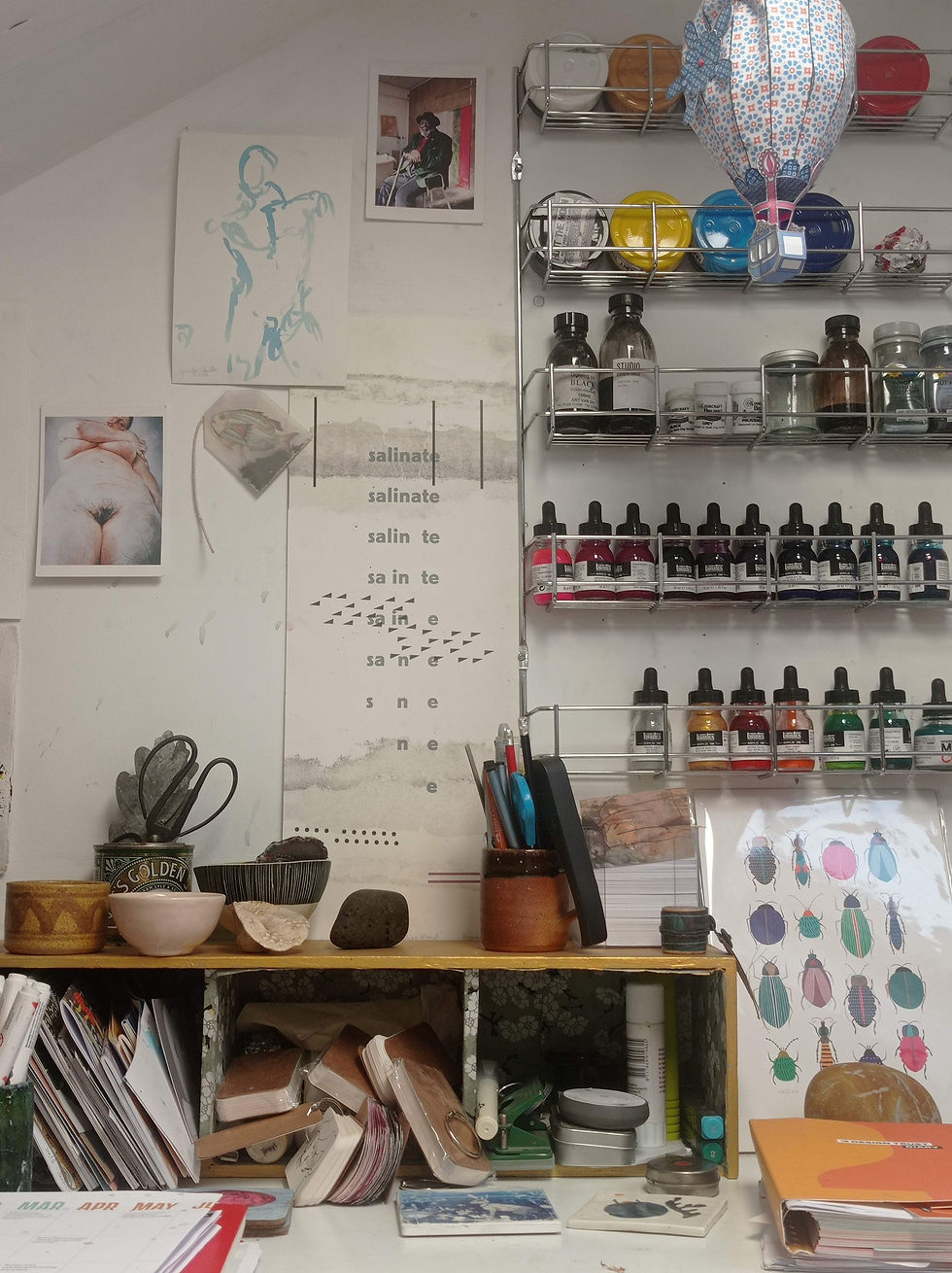
On the other side, I keep the painting setup. Paints, brushes, palettes, water pots, rags, and the pieces I am working on. This side is more forgiving. It can handle colour, texture, and the general evidence of a painting session.
That difference matters. Drawing and painting ask for different kinds of attention. Drawing often needs quick decisions, clean paper, and a clear view. Painting needs layers, drying time, experiments, and mess that makes sense. Giving each one its own side stops the materials from fighting each other.
The life drawing side needs clarity
Life drawing has its own rhythm. It can be fast, direct, and a little unforgiving. When I am working from a pose, even if I am drawing from references or preparing for a session, I do not want to hunt for a pencil or wipe paint from a surface before I start.
So the drawing side of the table stays as simple as possible.
I keep the essentials close:
drawing boards
loose paper and sketchbooks
charcoal and graphite
water soluble graphite, pencils and crayons
water soluble calligraphy pens are a favourite
a sharpening knife and a water spray bottle
The aim is not to make it look minimal. The aim is to make it easy to begin.
If I have only twenty minutes, I can still draw. I do not need to rearrange the entire studio first. That has changed the way I work more than any storage solution has. A usable space lowers the barrier to making something. It removes the small excuses that collect during the day. And trust me, I make myself plenty of excuses!
The life drawing side also gives me a place for looking. I can pin up sketches, compare gestures, and notice where a line has worked or fallen flat. In a room this small, the walls become part of the working process. They are not gallery walls. They are thinking walls.
I often find that a quick sketch left in view teaches me something later. I might not see the problem while I am making it, but I notice it while I am listening to the birds or passing through the studio to fetch something. A tiny room makes that kind of accidental looking much easier.
The painting side is allowed to be messier
The painting side has a different personality. It is more layered, more colourful, and more likely to contain a mug of brushes that should have been cleaned sooner.
I try not to let it become chaotic, but I also do not want to make it too precious. Painting needs room for trial and error. Sometimes the palette stays out because I know I will return to the same colours. Sometimes a piece needs to sit where I can glance at it for a few days, weeks or months .Sometimes the best thing I can do is stop touching it and let it become visible again. I have ledges along the back wall for these. Out of the danger zone, but in sight.
In a larger studio, I might have separate zones for wet work, dry work, storage, and packing. In this one, the zones are more like agreements. This side gets paint. That side stays clean. This shelf holds mediums. That ledge holds current work. The rules are simple because they have to be.
A small studio punishes vague categories. If I have a general “miscellaneous art things” box, it soon becomes a graveyard for forgotten tools. If I give things specific places, I use them more.
For painting, that means I keep the most-used materials within reach and store the less-used ones slightly higher or lower. I do not need every colour on the table at once. I need the colours I am actually using. I do not need every brush I own in the pot. I need the ones that suit the way I am working now.
That sounds obvious, but it took time to learn.
The temptation in a small creative space is to keep everything visible so it feels available. The problem is that too much visibility becomes noise. I work better when the room shows me the next step, not every possible step.

Paints to hand on the painting side of the studio, below the screen visible from the drawing side.
Admin has to live here too
The less picturesque truth is that the studio is not only for making art. It is also where I run the practical side of the work.
That means emails, listings, invoices, packing, planning, updating records, writing descriptions, sorting photographs, and keeping track of what needs to go where. None of that looks as appealing as a table full of colour, but without it, the work does not leave the studio.
I used to think of admin as something separate from the creative practice. Now I see it as part of the same ecosystem. Not the same mood, but the same practice. The painting needs a surface. The business needs one too.
Because the room is so small, I cannot leave admin spread out everywhere. Paperwork grows quickly. A few receipts, a notebook, a laptop cable, and a stack of envelopes can make the studio feel blocked.
So I keep admin contained in portable pieces:
a clipboard for current tasks
a folder for paperwork
a 3 month planner to give a specific focus to each month
a card file index for gathering notes from my endless journals
labels, tape, and cards in one reachable place
The laptop does not have a permanent place, as it’s used for other jobs. It comes out of the house when I need it, then goes away. That decision helps the studio stay an art space first. I can do the necessary business admin without letting it visually take over.
This is the balancing act at the centre of my working week. I need the room to support both the quiet, uncertain part of making and the practical, structured part of selling and sharing. I cannot pretend one does not exist. I also cannot let one swallow the other.
Storage is less about having more and more about choosing better
In a 3 x 2.5 m studio, storage cannot be an afterthought. Every box affects the floor. Every shelf affects the wall. Every “I’ll just put this here for now” turns into a small obstacle.
I have learned to ask a few questions before adding anything to the room:
Do I use this often enough to keep it close?
Does it need to be protected from dust, light, or paint?
Can it stand upright, stack safely, or hang?
Is it helping me work, or am I keeping it out of guilt?
Can it live elsewhere?
Art materials are easy to accumulate. They carry possibility, and possibility is hard to throw away. A paper offcut might become a collage. An old brush might make the perfect mark. A half-used tube of paint might be needed next month.
Some of that is true. Some of it is clutter wearing a convincing disguise.
I try to keep the useful oddments, but I give them limits. Offcuts go in one place. Packaging goes in one place. Experimental materials need to fit in their own area. Once the space is full, I have to use things, sort them, or let some go.
The best storage in the studio is not fancy. It is visible enough that I remember what I have, but contained enough that the room can still breathe. Jars, trays, folders, shallow boxes, clips, and shelves do most of the work, as well as slim shoe storage units.
Vertical space matters too. The walls hold tools, notes, and pieces in progress. The floor is too valuable to waste on things that could hang.
Small spaces make decisions louder
A tiny garden studio does not let me avoid decisions. If I start three paintings, lay out drawing paper, open a parcel, and leave yesterday’s mug somewhere unwise, the whole room tells me immediately.
That can be annoying, but it is also useful.
The studio gives direct feedback. If I cannot move, I have kept too much out. If I cannot start, the setup is too complicated. If I keep losing the same tool, it does not have a proper place. If admin keeps spreading into the painting area, I need a better boundary.
In a larger room, I might ignore those problems for longer. Here, they become obvious fast.
There is also a creative benefit. The smallness keeps the work close. I can see the drawing side while I paint. I can see unfinished paintings while I answer emails. I can see packed work waiting to leave while I start something new. The different parts of the practice stay connected.
That does not mean every day feels tidy or balanced. Some days the admin wins. Some days the painting takes over. Some days the best I can do is clear the table before I close the door. Some days I need to clear headspace before I can even step into the studio.
But the room has taught me that a studio does not need to be large to be serious. It needs to be usable. It needs to invite work rather than delay it.
The garden studio changes with the day
One thing I love about working in a garden studio is the separation. It is close to home, but it still feels like going somewhere. Even a few steps across the garden can shift the mood.
The light changes through the day. The weather changes the sound of the room. Rain makes it feel enclosed and focused. Blue sky days make the space feel bigger than it is. In winter, I become more aware of warmth, storage, and the need to keep things dry. In summer, the door can open, the windows shaded and the studio feels connected to the garden around it.
That connection helps. The studio is small, but it does not feel sealed off. A glimpse of plants outside, a bit of natural light, or the ordinary movement of the birdlife gives the room some breathing space.
What this small studio has taught me
The biggest lesson has been that a studio is not defined by size. It is defined by how well it supports the work.
My tiny garden studio holds my whole artistic practice because I have stopped asking it to behave like a large room. It cannot give me endless surfaces, hidden storage, or separate areas for every task. What it can give me is focus.
It asks me to choose what I am doing. It asks me to put things away. It asks me to notice when a system is not working. It asks me to respect the different parts of the practice, from the loose charcoal sketch to the careful admin task.
Most of all, it reminds me that art is made in real spaces. Not perfect spaces. Not always tidy spaces. Real ones, with paint water, paper scraps, to-do lists, drying work, and the occasional pile that needs sorting.
Inside these 3 x 2.5 metres, I draw, paint, plan, learn, write, think, and start again. The room is small, but the work has room to grow.


Comments